
Ovarian Cyst on Ultrasound: Should Every Cyst Be Treated?
Many women feel their heart sink when they see the word “cyst” in their ultrasound report. Even if the rest of the report is normal, that one word stays with them. They come home and search for it, and by the time they arrive at a clinic, they are convinced something serious is wrong.
If that is how you felt after your scan, you are not alone. And in most cases, the news is far less alarming than it seems.
The Short Answer
Not every ovarian cyst needs treatment. Many cysts are benign, small, and temporary. They may go away without any medication or procedure, especially if they are found incidentally and you have no symptoms. Whether a cyst needs monitoring, medicine, or further evaluation depends on what type it is, how big it is, and how it behaves over time.
Your doctor is the right person to decide what comes next — not the report alone.
Why the Word "Cyst" Causes So Much Worry
The word “cyst” tends to trigger fear because it sounds clinical and unfamiliar. Many people associate it with growths, cancer, or surgery — none of which may apply to their situation.
The truth is that ovarian cysts are extremely common. They can appear in women of all ages and reproductive stages — during the reproductive years, around menopause, and even in teenagers. In many cases, the cyst found on a scan is what doctors call a functional cyst, meaning it formed as a normal part of the monthly cycle and is expected to resolve on its own.
Seeing a cyst on an ultrasound is not automatically a diagnosis of anything serious. It is a finding — one that your doctor will interpret in the context of your age, symptoms, medical history, and the characteristics of the cyst itself.
Does Every Ovarian Cyst Need Treatment?
No. A significant number of ovarian cysts, particularly small, simple ones, do not require any active treatment.
Cysts That Often Resolve on Their Own
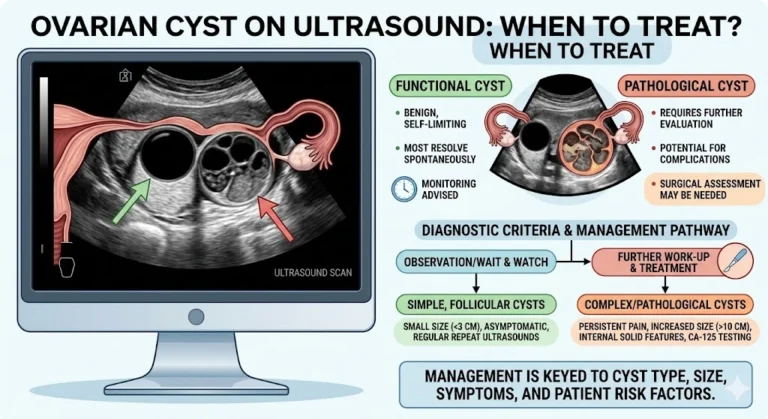
Simple cysts — meaning those that are fluid-filled, have smooth edges, and appear without internal complexity on ultrasound — are generally considered low-risk. In women of reproductive age, these are frequently functional in nature: a follicle that developed during the monthly cycle but did not release properly, or a small collection of fluid left behind after ovulation. These types often disappear within one to three menstrual cycles without any intervention.
In such cases, your doctor may suggest a repeat ultrasound after six to eight weeks simply to confirm the cyst has reduced in size or resolved. This is not a sign that something is wrong. It is careful, sensible monitoring.
When a Cyst May Need Closer Attention
Not all cysts are the same. Some have features on ultrasound that warrant further evaluation — thick walls, solid components, internal echoes, or an unusually large size. These features do not automatically indicate something dangerous, but they do mean the doctor will want more information before deciding how to proceed.
Similarly, if you have a personal or family history of certain conditions, or if a cyst persists without shrinking over time, your doctor may recommend additional tests such as blood markers or imaging to get a clearer picture.
Symptoms That Should Not Be Ignored
Many women with ovarian cysts feel nothing at all. The cyst is discovered during a routine scan or during investigation of something else entirely. In these situations, the cyst itself is often not the source of any problem.
However, some symptoms do deserve prompt attention:
Persistent or worsening pelvic pain on one side, a feeling of heaviness or fullness in the lower abdomen, pain during or after physical activity, discomfort during intimacy, or unexplained bloating that does not go away — these are symptoms worth reporting clearly to your doctor.
Symptoms That Need Urgent Review
Sudden, severe pain in the lower abdomen — especially if it comes on sharply and is accompanied by nausea, vomiting, or dizziness — should not be waited out. This can sometimes indicate that a cyst has ruptured or, in rarer cases, that the ovary itself has twisted. Both of these situations need medical attention without delay.
If you experience this kind of acute pain, please seek care the same day rather than waiting for a scheduled appointment.
How Ovarian Cysts May Affect Your Periods
Ovarian cysts and period changes often go hand in hand, though the relationship is not always straightforward.
Some women notice delayed periods, irregular cycles, or heavier bleeding when a cyst is present. Others notice spotting between periods. In some cases, particularly when cysts are related to a condition called polycystic ovary syndrome (PCOS), the hormonal picture is more complex and may involve missed periods, difficulty with conception, or other hormonal symptoms alongside the physical changes.
It is worth noting that not every cyst on an ultrasound means PCOS. A single cyst is very different from the pattern seen in PCOS, which involves multiple small follicles, hormonal imbalance, and often other clinical features. Your doctor will look at the whole picture — not just the ultrasound.
What Your Doctor Will Want to Know
When you bring your ultrasound report to a consultation, your doctor will likely ask a number of questions to understand the full picture. These may include:
How long you have had symptoms, if any. Whether your periods have changed recently. Whether there is pain and where exactly it is. Whether the cyst was a surprise finding or found during investigation of a specific complaint. Your age, whether you are still having periods, and whether you have had cysts before.
The characteristics of the cyst on ultrasound — its size, structure, location, and whether it appears simple or complex — will guide the conversation significantly. A small, smooth, fluid-filled cyst in a young woman with no symptoms is an entirely different clinical situation from a larger, persistent, or irregularly structured one.
When Treatment or Surgery May Be Considered
Most ovarian cysts do not reach the stage of surgery. But there are circumstances where treatment beyond watchful waiting becomes appropriate.
Medicine First
If a cyst is related to a hormonal imbalance or is causing symptoms such as period irregularity or pelvic discomfort, your doctor may suggest hormonal support or other medication as a first step. This is not always about shrinking the cyst directly — it may be about supporting the underlying hormonal environment.
When Surgery Is Discussed
Surgery is generally considered when a cyst is large (typically beyond a certain size threshold, though this varies), when it has worrying features on imaging, when it causes significant or escalating symptoms, or when it persists without change over several months of monitoring.
If surgery is recommended, it is most commonly done laparoscopically — a minimally invasive approach with a shorter recovery time. This should be discussed thoroughly with your gynaecologist, who will explain the reasoning, the approach, and what to expect.
The decision is always made based on your individual case. It is not taken lightly, and it is not the default outcome for most women who have a cyst.
What to Do After Seeing a Cyst on Your Report
The most important step is straightforward: do not rely on the report alone to draw conclusions. An ultrasound report describes what the machine sees. It does not interpret your symptoms, your history, or your overall health.
Bring the report to a qualified gynaecologist. Ask questions. Find out whether this cyst needs follow-up and, if so, when and how. Ask what symptoms would change the plan. Leave the appointment with a clear understanding of what comes next.
Waiting and worrying at home, or searching online for the worst-case scenario, rarely helps. Most of the time, a calm, informed conversation with your doctor is enough to make the situation much clearer.
Faq's
Can an ovarian cyst go away on its own?
Yes, many can. Simple functional cysts — those that form as part of the normal cycle — often resolve within one to three months without any treatment. A follow-up ultrasound is usually recommended to confirm this.
Does every ovarian cyst need surgery?
No. The majority of ovarian cysts, especially small and simple ones, do not require surgery. Treatment depends on the type of cyst, its size, whether it causes symptoms, and how it behaves over time. Many women are managed with monitoring alone.
Can ovarian cysts cause period pain or delayed periods?
They can. Some cysts are associated with pelvic discomfort, cramping, or changes to the menstrual cycle including delays, heavier flow, or irregular bleeding. However, many cysts cause no period-related symptoms at all. If your periods have changed recently, it is worth mentioning this to your doctor alongside the cyst finding.
When should I repeat my ultrasound?
Your doctor will advise you on this based on the type and size of your cyst. For simple, small cysts, a repeat scan in six to eight weeks is a common recommendation to check whether it has resolved. If the cyst is more complex or larger, follow-up may be arranged sooner or alongside other tests.
What symptoms need urgent attention?
Sudden, severe pelvic pain particularly if it is one-sided, sharp, and accompanied by nausea, vomiting, or feeling faint should not be waited out. These symptoms may indicate a ruptured cyst or ovarian torsion, both of which require same-day medical review.
Is a cyst on the ovary the same as PCOS?
Not necessarily. A single ovarian cyst is not the same as polycystic ovary syndrome. PCOS is a hormonal condition that involves a specific ultrasound pattern alongside clinical and biochemical features. One cyst seen on a scan does not mean you have PCOS. Your doctor will assess the full picture before making any such diagnosis.
A Calm Final Thought
An ovarian cyst on your ultrasound report is not, by itself, a reason to panic. It is a finding — one that many women have at various points in their lives, often without ever knowing it.
What matters most is what happens next: a clear conversation with a doctor who can look at the whole picture, explain what the cyst means in your specific case, and guide you toward the right level of care — whether that is a follow-up scan in a few weeks, some supportive treatment, or simply reassurance that nothing more is needed right now.
If you have recently received a scan report showing an ovarian cyst and would like a proper evaluation, please do not delay seeking advice. The sooner you have clarity, the sooner the worry can be put to rest.